Sunday, 12 June 2011

Tilford XI versus Grayswood XI – The Wood tuck into Tilford’s bowling attack

Grayswood finally welcomed their first win of the season with open arms, thanks to a sensational partnership of 197 between Soper and Tucker. The picturesque setting of Tilford in glorious sunshine prompted many sun seekers to witness probably the highest partnership of Grayswoods illustrious history.
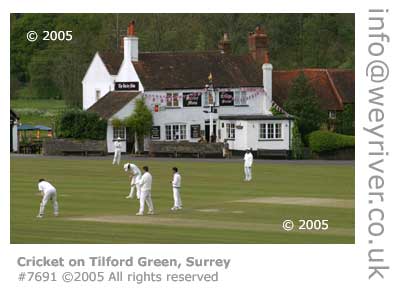

As is normal these days, things did not get off to a strong start for Grayswood as they began with 10 men. The lightning outfield and occasional four balls allowed Tilford to gain a head of steam up before too long. Broughton was introduced before early, and went some way toward decreasing the run rate, but the breakthrough did not come until A. Gloak Jnr arrived on the scene. He arrived late after an early morning exam (on a Saturday!) but firstball had Nesbitt caught in short by A.Green.  Capable opener Town-Jones was bowled shortly after and this seemed to instigate a middle period of the game whereby wickets would fall regularly, and runs would amble at 3-4 runs an over. 

James O’Brien made a steady 19 before clever fielding positioning led to him top edging back into the grateful hands of young Broughton. Robert Rist had earned a call up to the 1’s due to a mixture of missing players and good recent performances, and made the most of his opportunity. He bowled slightly back of a length whilst the batsmen were becoming increasingly aware of the need for runs and proved to be difficult to get away, even to the short leg side boundary. He deservedly picked up 2 wickets, but not before Broughton had dismissed the dangerous looking Walker. Having been hit for a glorious straight six the ball before, Broughton threw in the wrong un which did for Walker and ensured Tilford did not get too large a total.

Tight finishing from Rist and I.Jackson kept them below the 200 mark after 48 overs, a total Grayswood were confident of getting on a solid batting track, providing they kept wickets in hand.

The reply did not however, get off to the best of starts when C.Kent was caught in Gully for a 1st baller. The first few overs were very much a backs to the wall job, as Town-Jones and Martyn extradited uneven bounce with the new ball. Skipper for the week tucker, decided the best form of defence was attack as he unleashed flamboyant strokes on both sides of the wicket. He was ably assisted by the dogged Soper at the other end, who was determined not to give his wicket away at any cost.


Whilst Soper dug in nudging and nurdling the singles, Tucker could not contain himself and dispatched all bowlers around the ground. His blistering 114* came off of just 90 deliveries, and included 12 fours and 6 sixes. The rest of the team were not needed as the two led the team home with probably the highest partnership of any wicket in Grayswoods history as Soper emerged with a chanceless 69*.

Grayswoods season may well have taken a turn for the better then, and if Tucker can remain in form, they will fancy their chances against any team in this division. Grayswood will hope this is the much needed win that will enable them to propel up the table and to a position more representative of this talented outfit.

Man of the Match: Alex Tucker: 114* with 12 fours and 6 sixes
Donkey of the day: Callum Kent: Golden duck and only wicket to fall

Tuesday, 7 June 2011

Grayswood 1st XI Versus Wrecclesham 1st XI– Depleted Grayswood slump to heavy defeat

With 6 regular first team members missing, Grayswood were left to field a weakened team of 10 men against a Wreccelsham side who are enjoying their first season in the Ianson top division. Electing to bowl first, The wood were soon up against it.

After Jackson saw Windeatt cut the third ball of the opening over to A. Green  at backward point, Grayswood spirits were high. This was to be a rare occasion as Wrecclesham amassed 55 runs in the opening 5 overs, taking a particular liking to the inexperienced Varnes whose opening spell of 3 overs none for 33 is one he will be wanting to forget. Stand in skipper tucker looked toward newly converted off spinner Green to tighten things up, and he was unfortunate not to pick up a scalp early on as his elder brother J.Green spilt a tough catch sliding in from the long on boundary. This was not a costly miss however as “the camel”, bowling line and length had Wright caught behind by the talented C. Kent. Dangerous C. Board swiftly followed as he mistimed a cut shot into the grateful hands of Broughton in the covers. Spooner and Bate ambled towards drinks as Grayswood fought back, and were unfortunate to see edges from Spooner fly agonisingly wide of first slip on a couple of occasions. Luck was not all that could be blamed however, as P.C West also spurned a chance on the cover boundary, as young spinner Broughton tied him in knots.

The spin twins saw the wood into drinks having regained some sort of control and managed to strangle the runs effectively, giving renewed hope to the fielding side.

A lack of concentration seemed to be the downfall of Bate as, first ball after drinks, Broughtons  rank full toss was mishit high into the air for Varnes to cling on to gratefully in the midwicket region. This signalled a boring period of rebuilding for the visitors, as they crept past 150 due to tight bowling from Jackson and Broughton. After dislodging Spooner for a carefully crafted 50, D Vasey provided some much needed momentum into the innings with a blistering 35 off 15 deliveries. He took a particular liking to the Camel, and hit one six which may well have ended up in Witley. Eventually the innings was ended as Vasey’s Cameo came to an end and Grayswood were left 49 overs to chase 196. The 10 wickets were shared between Broughton (4-46) and Jackson (6-76).

Needing only 4 runs an over, Grayswood kept up with the rate as Soper and Kent provided an early platform on which to build. Soper was to be the first of many wickets for spinner Board. Stand in Skipper Tucker came to the crease fresh from a blistering 92 in the midweek Stevens cup fixture, and seemed to still be in 20-20 mode as he crashed deliveries to the boundaries with relevant ease. The tide turned however, when he was unfortunately given out LBW after clearly hitting the ball. The wickets of West and Kent soon followed and the well documented Grayswood collapse commenced.

Green, struggling for runs this season, provided a resilient (boring) display of batting until Board tossed a slow one up that he fancied having a go at. He did not quite middle it however, and was dismayed as Andrew Collins dived full length to his right to take a stunning one handed catch. This opened up the vulnerable tail, as Board ended the innings in the next 4 balls and with an impressive 8 for 19 from his 11 overs.

Grayswood can take solace in some areas, such as their fight back after an early setback and the abilities shown by their youth, but they need to get a grip on things soon if they wish to remain a top division side.

Man of the Match: Ian “The Camel” Jackson – 6 for 74
Donkey of the Day: James Varnes – 0 for 33 from 3 overs and a Golden Duck (On Debut)

Monday, 2 May 2011

Dogmersfield XI verses Grayswood XI – old rivals meet again

Grayswood travelled to Dogmersfield for an early season encounter, and were once again left to rue missed opportunities, as shoddy fielding dashed any hopes they had of stealing points off their old rivals.

Electing to bowl, Grayswood were hoping to improve on last week’s lacklustre fielding display, but these hopes were dashed early on as the dangerous Illyas was dropped at first slip by Handley, only three balls into the innings. Nash remained undeterred however and fashioned another, difficult chance, as Banjo couldn’t hold onto a clipped shot to square leg, this time from the flamboyant Nabel. Mr July sought revenge and his unpredictable bowling action was causing trouble. Continuing his stroke play, Nabel hit a high one to long on Handley who was always struggling under the blistering wind, and once again could not hold on to provide a much needed boost to this discouraged Grayswood outfit.

Looking for inspiration, skipper Gloak turned to newly found off spinner Al green who struck Swann like in his first over to dismiss Nabel for 65. This break through enabled the wood to seize the initiative after drinks, and “The Camel” bowled with swing and accuracy to dismiss both Illyas (Caught J. Green) and Suliman in quick succession. These two operated well in tandem as Dogmersfield looked to propel their innings. The opposition were assisted in this however by some shambolic fielding, off youngster Green in particular. Openers Gloak and Nash returned for second spells and were rewarded as the batsmen threw caution to the wind. H. Nash was particularly relieved to see a catch finally taken off his bowling, and must have been wondering what he had done to deserve 4 dropped catches off his bowling already this season. Gloak finished with a couple of wickets as Dogmersfield declared after 45 overs with 197 on the board.

Dogmersfield once again started the better of the two sides as Grayswood fortuitously saw both openers dropped early on. The difference to their counterparts however was that they were unable to capitalise, as Hussein’s in swinging deliveries wreaked havoc amongst the Grayswood top order. Evidence of this would be the abysmal scorecard in which only 1 of the top 7 amassed a double figure score. There was a brief revival from Handley, who was desperate to make up for his earlier mistakes, and Jackson, but they were unable to prevent the seemingly inevitable victory for the home side. After this partnership was broken the end was neigh, as both Greens swiftly departed to allow Dogmersfield all 10 points.

All in all, Dogmersfield deserved their victory on a ground that has haunted Grayswood in recent years. There is no rest for the wicked however, as the disheartened wood must travel to Frensham next week to try and get their season back on track, a fixture that saw 578 runs and 13 wickets last year. Not much to live up to then.

Donkey of the Day: Dave Handley
Man of the Match: Ian Jackson (2 for 24 and 10)


Monday, 25 April 2011

Grayswood 1st XI versus Harting 1st XI – Opening day of the Season

Grayswood had a strong line up for the visit of Harting and were looking for an early season boost to their title aspirations. After winning the toss however, “the wood” were left to rue missed opportunities, as an uncharacteristically lacklustre fielding display let Harting amass 176 off their allotted 48 overs.


Reliable slip fielder Tucker failed to cling on to an edge in the 3rd over after good work from opener Nash. Grayswood were undeterred however, and soon fashioned another opportunity. Unfortunately for them it was that man tucker again who made a new best friend by snapping at his second chance. Hale continued to frustrate, and was fortunate on numerous occasions for edges or mistimed shots to fall inches short of the disheartened fielders. Norris on the other hand, proved to be a classy stroke maker, with cover drives straight out of the training manual.


 It took until there were 103 runs on the board, to finally dislodge the opening pair as Norris, having just celebrated reaching 50, edged to Tucker who took a smart diving catch down to his left off Al Green. This did however, serve to solidify his position as donkey of the day as, in finally catching the ball, he injured himself and would prove to be unable to bat in his preferred slot of number 3. The only positive to be taken from this injury was the humorous fielding he now had to conduct with his left hand. Grayswood plugged away as Harting attempted to propel their innings but after Gloak senior finally dislodged Hale the runs dried up, and wickets fell quickly as Conway and Nash got in on the act. Excellent death bowling in the last few overs from straight bowler Gloak and Nash enabled Grayswood to keep Harting at a total that should be within reach of their strong batting line up.


Grayswood required a rate of just over 4 runs an over and T.Nash, ably supported by Soper provided a solid start to the chase. Fielder was bowling with some pace and bounce but his misdirection cost him dear. Nash dispatched a short wide one to the boundary with an imperious cut that landed him shot of the day. Soper did get in on the act however and came a close second with what can only be described as a “no look hook” (coined by H. Nash) into the Grayswood tree. Having amassed 53 runs, “the Wood” were cruising until Deakin, who had bowled with guile for no reward had Soper caught at mid off. This proved to be a pivotal time to take a wicket as Gloak Junior played down the wrong line of one and Nash flayed a full toss towards the pavilion only to see it snaffled impressively by the waiting fielder. This sparked the traditional mini collapse of the middle order as young Bates bowled with accuracy beyond his years to dismiss H.Nash (8) and J.Green (O) in quick succession.


 Grayswood had slumped from 52 for 0 to 85 for 5 in no time at all and found themselves in the unenviable position of needing runs in a timely fashion without the loss of more wickets. Skipper Gloak and Ian “the Camel” Jackson set about rebuilding the innings with some flamboyant stroke play backed up by a strong rearguard. As Grayswood were seemingly getting back in the groove however, the Camel’s Cameo innings of 21 was brought to an end when he nonchalantly chipped into the grateful hands of mid on. Kent (0) swiftly departed and with the winning draw in sight Jonjo “Banjo” Conway made his way to the crease. Mr July helped the skippers’ aggressive batting with quick running between the wickets but was unfortunate to middle a chip shot down to mid off. The crowd were growing anxious as the winning draw had been attained and the banjo’s departure left Grayswood requiring an unlikely 20 runs to get off 2 overs with only 2 wickets left. The tension grew more still as A. Green was stumped sharply by Norris to give Harting a glimmer of hope. Tucker, tacking one for the team and struggling to hold the bat aloft, was called upon to face out the rest of the over without fuss. All that remained then was for the skipper to see his side hold out for the 4 points in the winning draw. Fielder, with 3 wickets to his name was given the ball and the young man again chose the back of a length aim it at his head tactic. Bizarrely, this almost worked as Gloak (45 N.O) flapped at a short one only to see the ball land safely between fielders, as a grateful groan echoed around the ground.

The final result then, a disappointing winning draw from a Grayswood side expectant of much more, and their fielding will need to be much improved to stand any chance against their old rivals Dogmersfield next week.

Donkey of the day: Alex Tucker.
Man of the Match: Andy Gloak (3 for 29  and 45 not out)

Wednesday, 20 April 2011

The final blog - Social Media Marketing


Social Media are defined as the various online technology tools that enable people to communicate easily via the internet to share information and resources (About.com). Developing from this, I am certain that if the general public were questioned as to examples of social media the majority would provide the likes of Facebook, Twitter, Youtube and blogging to name but a few. This is due to the increasing significance these sites have on our everyday lives, and below is a video that I feel solidifies this view, as do the statistics on Banking2020.com.

.

The question is then, how can, and do, companies utilise the social media phenomenon

The ability to reach out and engage with consumers via social media is increasing every day, and Youtube is at the forefront of this. Youtube gives the ability to share with millions of viewers simultaneously and the creators of the 3rd instalment of the Transformers trilogy utilised this platform to its full effect, implementing teasers to generate hype and the widely anticipated movie (out July 1st 2011) has over 22 million views. This type of Marketing is brilliant at creating speculation and anticipation as it hypes up interest in the product, months before its release (Crawford & Benedetto, 2008).

Since the infamous Dot Com bubble bursts, companies have instilled more confidence in the internet and it's sociability factor, first with MySpace and now the ever dominant Facebook. These sites allow for "hyper targeting" which "allows for greater relevance for a particular advert" (The Times) this results in the adverts seen on ones profile page, having been tailored for that specific person. Let me make an example I have used before; I am a keen sportsmen who goes to Bournemouth University, and what do I see when I go on my profile page? An advert for things to do in Bournemouth and one for a discount for a fitness aid (seen below).


These adverts generated are based on the "likes" of a person and their interests. Companies use this information to tailor adverts to specific users, which makes commercial and economic sense; they are finding their target market through the online data I have supplied about myself. There would be little point in running these adverts to a young girl who lives in Australia. This is one way in which social media sites are interactive.

Rafaeli (1988) refers to full interactivity as different to simply a reaction because of "the incorporation of reference to content, nature, form or just the presence of earlier reference" (pp119). E.g. a company has seen I have mentioned living in Bournemouth, in profile bio or statuses, and they use this previous information to tailor their advert to me. 

Interactivity is further increased as companies look to utilise the availability of co-production and crowd sourcing. Crowd sourcing is a way of utilising cheaper, sometimes even more knowledgeable amateurs as " smart companies in industries as disparate as pharmaceuticals and television discover ways to tap the latent talent of the crowd" (Howe, 2006, pp2). Companies are, in a way, crowd sourcing by making feedback available and actively encouraging consumers to inform them how they could be better via their social networking facilities. An example would be NetSquared, a company focused on intersecting technology and social impact, they provide an area on their site whereby readers and bloggers can provide feedback on how the companies’ blog can be improved. By communicating with consumers, be it blogs, Twitter or Facebook, companies can gain insight into any potential shortcomings of a product and satisfy its market. Furthermore the costs of running such a site are minimal. This is not however, to say that the views of the public are necessarily correct and the suggested changes need to be made.

I see Twitter as a way for companies and celebrities to promote themselves and inform people about potential news. An example would be IBM, who use their Twitter account to update consumers on information regarding themselves. A recent tweet states that:
New York State Recovers Millions of Dollars in Tax Debt With IBM Technology -http://www.ibm.com/press/us/en/pressrelease/34304.wss

IBM are clearly using this is an avenue to promote their work and news about themselves, which is why I find it interesting to follow. A consumer can find out the latest news about their favourite company or celebrity icon in the touch of a button, and the demand for Twitter has led to a Twitter app being created. I believe that the further technological advancements of I-phones and androids is actually another reason for companies investing in social network sites and here’s why. 

There are over 5 billion mobile phone connections worldwide (BBC, 2010), and the advancement of mobiles is decreasing the digital divide. Stump et al (2008) believe "mobile holds the potential for developing nations to leapfrog technologically since they are able to bypass the development of landline telephone systems" (pp398). The capabilities of these phones are increasing and the social media sites have jumped on the app bandwagon, mobile phones are actually being sold with a built in app for these sites due to their popularity. 


Combine this with the 3g capabilities of a modern day phone and these sites can now be accessed not only at the touch of a button, but in the most remote of places. Twitter can be accessed more easily, ergo, the companies Twitter site can also be accessed.
As with most things nowadays, there are of course ethical considerations that need to be made. Is it ethical to use data that people have provided, such as their hometown for means of advertising? I for one believe it is fine to do so and my blogging over the last few months would show this, and there are reasons behind my beliefs. First and foremost the advertising from companies on a Facebook page is very unintrusive and only takes up a small percentage of a person’s page. This is the key to social media marketing as consumers are often unaware that the information put online is readily available for companies as the diagrams I use below show.


I have used this example before but believe it shows how much more use companies can get out of social media websites, with that wealth of information available, strategic marketing campaigns can be utilised and can be hugely rewarding. Consumers can easily become irate if unwanted information about them is found out and negative word-of-mouse may occur, but as Eric Schmidt (Google CEO) says “If you have something that you don’t want anyone to know, maybe you shouldn't be doing it in the first place."


Word Count 1098

References:

About.com. 2011. Social Media – Social Media Definition. New York. Available from: http://jobsearch.about.com/od/networking/g/socialmedia.htm [Accessed on: 16th April 2011]
                
Banking2010.com. 2011. Social Media Statistics: By-the-numbers. UK. Available from: http://www.banking2020.com/about/ [Accessed on: 21st April 2011]

BBC NEWS. 2010. Over 5 billion mobile phone connections worldwide. UK. Available from: http://www.bbc.co.uk/news/10569081 [Accessed on: 20th April 2011]

 Crawford, M & A. Di Benedetto, New Products Management, 9th Edition.UK, 2008, McGraw Hill Irwin

Howe, J., 2006. The rise of crowdsourcing. Wired, 14(6). Available from:

Rafaeli, S., 1988. Interactivity: From new media to communication, Sage Annual Review of Communication Research: Advancing Communication Science, 16,110-134.

Richards, J., 2007. Social Networks get personal with “hyper-targeting”. The Times. UK. Available from: http://technology.timesonline.co.uk/tol/news/tech_and_web/article2810857.ece [Accessed on: 18th April 2011] 

Stump, RL., Gong, Wen., Li, Zhan., 2008. Exploring the Digital Divide in Mobile-phone Adpotion Levels across Countries. Do population Socioeconomic Traits operate in the same manner as Their Individual-level Demographic Counterparts? Journal of Macromarketing. 28(4) pp397-412.


Wednesday, 30 March 2011

The Ethical Issues of Social Media

In Daryl's guest lecture, we looked at the fall in traditional media such as newspapers, which actually links in with my work from Loyalty Marketing. Firms are now providing news online, and I read a statistic that stated 75% of the UK access news from online sources. Mintel boasts statistics that show the Guardian online, as of January 2009, have over 30 million different users per month, a 59.4% increase from March 08.


Daryl pressed home what I already knew, that Facebook is a very effective tool in driving sales of products, but could also be a platform for the development of ideas, largely via a crowdsourcing scheme. He mentioned that media is turning digital and I couldn't agree more, with 3G available on an ever increasing scale, it makes sense for national dailies to expand into the digital environment or fear getting left behind. Further highlighted was that, not only are traditional media "going online", but older people are also getting into social media and more technologically adept. Digital buzz blog's figures that prove this belief that older generations are increasingly becoming part of Social Media are shown in the figure below.


The best way for companies to learn how to utilise Social Media sites, seems to be to have a play around with them in an almost trial and error approach. One way that was attempted was Astroturfing, which could be used on social media to fake grassroots campaigns that create the impression that large numbers of people are demanding or opposing particular policies. (1. Monibot, 2011) Tobacco companies have a long history of creating these campaigns to fight attempts to regulate them, and the anonymity is an area that companies can utilise to create these campaigns, so regulation to ensure Astroturfing is not occurring, is required.


Companies need to listen to online forums and social media sites to become aware of areas that need addressing, engaging with the audience allows substantial feedback to be acquired. Transparency however, is key, being upfront and informing consumers of your intentions so the consumer knows who they are talking to and to what end.


The privacy of Social Media is constantly under scrutiny, as one of my previous blogs outlined. It is thought nowadays that a persons web shadow is becoming increasingly important, and this actually led to me changing my privacy settings to ensure only friends can see my Facebook profile. I did this because "Half of employers reject a potential worker after look at Facebook page" (2. The Telegraph, 2010). The question is though, is this ethical? 

A company such as Nike can use social media such as their Twitter and Facebook pages to communicate with their target markets, and utilise the availability of dataveillance. This is the "systematic monitoring of people's actions or communications through the application of information technology" (3. Clarke, 2003). This allows them to monitor what consumers are looking at, liking and becoming fans of, then this enables them to provide more relevant and specific marketing communications with potential customers. In my mind, as long as the interaction between the company and the consumer is not too intrusive, (constant messages getting in the way) I don't believe that it is unethical. 


With reference to employers, I put it to you, if you could find out more about a potential employee than the CV originally indicates , which supposedly puts them in as good a light as possible, why would you not? It is not unethical to utilise the avenues available unto you, and I have recently learnt that journalists are asked in interviews these days on their Social Media searching capabilities, so this is indeed a very real practice. I have used this quote before, but due to its relevance here specifically, i felt i should include this Eric Schmidt (Google's CEO) quote “If you have something that you don’t want anyone to know, maybe you shouldn't be doing it in the first place." 


Social Media involves sharing information about oneself on the web which then is free for all to see, if consumers do not wish to have this information used by marketers, it is their prerogative to regulate their own behaviour. Brands need to protect users privacy within the regulations in which they operate, but beyond this i feel that ethically speaking, marketers aren't doing a whole lot wrong utilising these dataveillance methods. These marketing methods are going to become more and more the norm as traditional media fades, and the likes of TV adverts, thanks to availability of modes such as Sky Plus, become less effective. The key is to remain as unintrusive as possible, and these targeted ways of communicating will benefit marketers providing the do just that.


References:
1,  Moniton, G., 2011. The need to protect the internet from "astroturfing" grows ever more urgent. The Guardian. 23rd February. Available from:  http://www.guardian.co.uk/environment/georgemonbiot/2011/feb/23/need-to-protect-internet-from-astroturfing [Accessed on 24th March 2011]


2. The Telegraph, 2010. Half of employers "reject potential worker after look at Facebook page". The Telegraph. 11th January. Available from: http://www.telegraph.co.uk/technology/facebook/6968320/Half-of-employers-reject-potential-worker-after-look-at-Facebook-page.html [Accessed on: 25th March 2011]


3. Clarke, R., 2003. Dataveillance 15 years on. Available from: http://www.anu.edu.au/ people/Roger.Clarke/DV/DVNZ03.html [Accessed on: 25th March 2011]

Thursday, 24 March 2011

The Public Sphere in Marketing

Before even attempting to put this concept into the field of marketing, i must first get my head around it's meaning. The public sphere, as far as I understand is where the discussion of public affairs takes place and is conducted by supposedly "elite people". The lecture outlined that the media acts as a public sphere for common society and the likes of Rupert Murdoch could, to a certain degree, control this sphere.


With digital divides decreasing, and the potentially anonymous freedom of Facebook, Twitter and Blogs, spaces of discourse provide an arena for a more representative public sphere than the elitist form. The underlying theme I received from the lecture is that the ideas from online forums are judged more on merit than the standings of the speaker. People utilise online services such as rating eBay sellers or their recent stay in a Premier Inn to help those around them. Complaining about poor service (click the link to read a very comical one), is not done for the sheer fun of it, but because the facility is so easy to use and they are informing the general public of their experiences. This availability of course means that increasingly more attention to detail is needed to prevent customers starting a slippery slope of bad word-of-mouth but Coca Cola have handled this problem in the wrong way.


I listened to a very intriguing podcast from The Economist on how to counter act bad word-of-mouth,which is easy to announce on the global stage thanks to new media availability. Coca-Cola have a web page dedicated to address rumours about themselves and try to refute them. The economist, and more specifically Derek Rucker and David Dubois of the Kellogg School of Management, believe that by restarting the rumours coke are propagating them. Coke then, instead of trying to deny these rumours should counter by ensuring the positive steps they are taking, such as reducing carbon emissions, are circulating also. The anonymity of blogs and web 2.0 can be utilised by companies for self promotion, of course steering clear of Astroturfing.


It was also very interesting, yet perhaps not too unexpected, to learn in the lecture that the BNP had the largest forum during the last election, as it is an opportunity for people to express there racist and extreme views anonymously, or as i like to call it cowardly. 


Erickson and Lilleker (2010) believe that "the internet, and in particular the architecture of participation central to web 2.0 media technologies, has exacerbated the chaotic nature of the communication environment" (pp1). This led to them implementing a more diverse communications programme for Ed Balls in the last election that utilised new social media. This is a method that i suspect we will see increasing in the near future, companies utilising these sites for communication. I have already spoken in previous blogs about companies Facebook pages and Twitter feeds, but the ability to self promote via these sites can be utilised further. IBM have a blogging system, whereby their employees post their views on the companies in  blog form, which are easy for all to view. This not only promotes the flat hierarchical structure of IBM but gives them an opportunity to gain feedback from employees and questions from the public. 


These strategies I feel will be incorporated more and more by corporations to stay in touch with the public sphere, and perhaps exploit crowdsourcing for discussion and progression with product concepts.


References:
Erikson, K., Lilleker, D., 2010. Campaign Websites and Hypermedia Campaigning: Lessons from the Ed Balls Labour Leadership Campaign, Parliamentary Affairs.  Available from: https://sites.google.com/site/dlilleker/files/Campaignwebsitesandhypermediacampaigning.doc?attredirects=0&d=1 [Accessed on 24th March 2011]

Monday, 21 March 2011

Challenges of Promotions the Whole world can see

Promoting on the internet, why should Marketers do it?

Connected Kingdom provide statistics that show the internet has contributing more and more to the UK's GDP (7.2%/£100 billion in 2009), and 60 % of the internet economy is driven by consumption, which is becoming ever easier. They also suggest that by 2015, the internet will provide 10% of the UK's GDP. Along with this comes the growing knowledge that with technology increasing at an exponential rate, the internet will continue to be a significant part of consumers lives. 

There is a challenge here already for companies to think of, as The Guardian recently reported that the internet has run out of space, there are no new internet addresses available, as almost 4 billion have been used up since it's creation 40 years ago. This will lead to the implementation of new systems being installed in the next 12 to 18 months, which means a company looking to launch a website will have to be aware of the changing of Internet protocol versions (IP's) and ensure they are using the newest IPv6 type. Charles Arthur and Josh Halliday wrote "This could mean that in a year's time you may hear about a new site – yet when you type its address into a web browser or click a link to it on a web page, your computer simply won't connect to it because it will use an addressing system entirely different to the one used before."(2011).


The key for a company promoting on the internet is to establish trust with the consumer and to develop a good reputation. In this digitally communicative world, the speed of transactions is increasing and desire is easier to satisfy. Janice mentioned in our lecture that desire is cyclical, i.e. excitement leads to desire leads to excitement and so on and so forth. With the internet providing a platform for faster, easier consumption, this cyclical system is accelerated, so for an aspiring company, there is a need to offer diverse products that satisfy many different needs, not unlike that of Ebay, which provides a way to tangibalize desires.

There is, and probably always will be, a debate surrounding the degree of privacy that is lost due to the advancement of the internet. An aspiring company would need to be aware of the various laws that are in place to ensure that a certain amount of privacy is sustained.

It is assumed that companies will keep individuals information private, but the data protection act, as Connor pointed out in our lecture, is not necessarily geared towards absolute privacy with ambiguous terms such as adequate, necessary and not excessive. This provides a certain degree of leeway for a company, and Alex Krotoski believes that privacy rights are effectively lost by utilising the free services of the internet. The information a consumer gives is a virtual currency and how they "pay" for the services they are using. 

Customer data is pivotal for a marketing strategy to be effective and the information that consumers gives allow the promotional objectives of companies to be accomplished. I have spoken before on the way in which companies utilise personal data on Facebook to provide relevant adverts on one's profile page. This has changed in recent years as Facebook has grown and the ability to utilize personal data increases, as the two charts below indicate.


The blue area shows the level of personal data that is available for Facebook (provided by Matt Mckeon.com, and subsequently enables the personalized advertising techniques they implement.

To conclude, a company looking to promote a product on the internet will face challenges, as previously explained, but the rewards to be gained largely exceed the costs. Furthermore, whilst privacy is an issue that needs to be looked at, the plethora of information consumers provide, enables marketers to target consumers specifically with products the consumer may actually want, as opposed to random, generalized promoting. In my eyes, there will always be ways for companies to find information out about a consumer once it is on the world wide web, if there is information that a consumer does not want to be known, then they should not be putting it on the internet. I agree with Google CEO Eric Schmidt and leave you with a quote from him, "If you have something that you don't want anyone to know, maybe you shouldn't be doing it in the first place".

References:
Arthur, C., Halliday, J., 2011. Internet almost out of space with allocation of last addresses. The Guardian. 1st February. Available from:
http://www.guardian.co.uk/technology/2011/feb/01/internet-last-addresses-ipv4-ipv6 [Accessed on: 11th February 2011]

Adding words and Analysing, Google's way forward

I have decided to try and apply Google Adwords and Analytics to a local sports store to where I live, called Sports locker, who I feel could really benefit from search engine optimization (SEO)


Google Adwords is Google's main advertising product and source of revenue, which conor's lecture showed an overall revenue of $29.3 billion, 97% of which ($28.2 billion) came courtesy of advertising revenues. This works by a company creating ads and choosing keywords, which are words or phrases related to their business. When searches on Google are made using one of the aforementioned keywords, the ad can appear next to the search results. This ensures advertising is made toward an audience already interested in the companies products.


Sports Locker, is not a phrase that will frequently be put into a search engine, so to utilise the Adwords capabilities, I would recommend a phrase match keyword option with "sports surrey" as the Phrase match word. This way the ads should show in searches such as "sports in surrey", "Sports store surrey" and "Surrey sports shop".


Due to the specificity of this search term, the ad will appear in more relevant searches and provide more significant return on investment, as the graph below demonstrates, it is more long tailed phrases which generate more specific responses.


Google Analytics shows you how people found your site, how they explored it, and how you can enhance their visitor experience. With this information, you can improve your website return on investment, increase conversions, and make more money on the web.  


Sports Locker can benefit from utilising Google Analytics as it allows them to track which pages are generating the most traffic and which adverts are performing the best. The reports available from Google Analytics provide information that will enable Sports Locker to enhance consumers online experiences and find areas that need to be improved.


On another note, Google has recently changed its search algorithm, because people have created web pages to match search terms (Google Adwords) when you go to them, and when they are selected they are just full of ads irrelevant rubbish, it is in effect web spam.


There are content farms on th internet who produce lots of content then sell advertising against it. An example would be Demand Media, who look at what people search for on Google and Twitter and what terms are trending etc. Following this, they write articles that satisfy these searches, Demand Media actually employ 5/6000 journalists that write the specific content and key words for them to attract the web searches, and then sell ads again when the consumer is on their page.


Google are trying to get rid of these content farms by changing their algorithms and trying to ensure that the search engine is still run in a fair way, whereby the top sites are there on a popularity basis as they have the most hits. (The Economist, 2011)


References: 
Babbage, A 3D sensation. The Economist. 2011, Podcast, iTunes. 2011 March 02

Sunday, 27 February 2011

The Seamless brand

This weeks blog seems to have me in a bit of trouble in trying to relate the reading and seminar work to that of the lecture, yet the most prominent connection i can make is the relevance of "meaning". Verganti (2009) provides reasoning to suggest that "people do not buy products but meanings" (pp4), and this relates toward emotional and psychological meanings consumers place amongst both products and services. Verganti also believes that firms need to look beyond the aesthetics of a product and instead aim to understand the true meanings users give to products.


Looking back over the lecture slides it is made immediately obvious, perhaps by over use of 404 examples, that companies are aware of the most minute details of their brand experience. This is in order to provide not only the service promised in a as efficient a way as possible, but to try and ensure positive, almost fond, recollections of the brand are created. Positive word of mouse from something as simple as a helpful, branded 404 page can be the difference between a repeat purchase or a dissatisfied customer.


A favourite example of how brands have little additions that enable the brand to stand out yet still link back to the underlying reasoning of the brand is, once again, Compare The Meerkat.com. I am aware i mention them almost weekly, and no i am not on any sort of payroll from them, they are simply a consistently appropriate, original example. In relevance to this particular blog, they are an example of how a company utilise these little extras in order to reiterate the underlying brand, as the snap shot below from the home page shows


The reading also provides an example of how the Nintendo Wii launched a motion-sensitive based games console that instead of adapting the current game play with more powerful graphics and performance like it's competitors, transformed consoles into an active workout for everyone. This example of a meaning that was not asked for or even expected, has proven to be so successful that the competition in the form of Sony's PlayStation move and Microsoft's X-box 360 have had to follow suit with their own versions of the Wii.


With virtual reality becoming an ever-increasing part of day to day life, as interactivity via the likes of social media sites and online shopping is more readily available, firms need to be aware of the potential consequences that can arise. In an everyday shopping environment, a customers experience can be tailored by anything from the staff on hand and product availability to the facilities on hand, such as fitting rooms. With regards to online shopping, the customer service element is more difficult and harder to maintain as customers experiences can significantly differ from one to another. The way to reduce the difference in experiences would be to make the interactivity of the online experience as easy to use and similar to that of the real thing, this should provide optimal customer satisfaction levels whilst also enhancing the brand experience.


Taking all this into consideration, companies need to ensure that experiences are enhanced, possibly via correct attention to detail, and that design driven innovations could be the way forward in increasingly saturated markets. this allows companies to understand consumer needs and wants, as well as manipulating them with design driven innovations. Service delivery can be improved by understanding the emotional meanings associated with experiences and furthermore, this allows products and services to be produced on a more meaningful basis.


References:

Verganti, R., 2009. Design driven innovation - an introduction, Design-driven
innovation: changing the rules of competition by radically innovating what things mean. Harvard Business Review pp.1-16

Sunday, 20 February 2011

Mobile Marketing


Mobile phones are the largest form of media in the world, with over 5 billion of the world’s population currently possessing one and this number is increasing exponentially. Phones have come a long way in the last decade, where 10 years ago there was a lot less choice and I assume most people would have had a Nokia 3310, a true classic of a phone. Nowadays there are a huge variety of phones and it seems as if the most popular phones are the ones that provide the most applications and interactivity options. These are currently classed as smartphones, with the likes of Samsung, I-phone and HTC being the trend setters.

These phones offer all sorts of downloadable applications from games and weather updates to health and fitness guides, there have now been over 10 billion apps downloaded from I-tunes (only applicable for Apples devices) alone. The new modern ways of the consumer embrace these apps by making micro-payments which can be as little as 50p for a simple game, a stark contrast to previous trends when consumers would never have adopted such a concept. This shows just one new way that companies market their product or elements of it through this new "app era". A prime example is one that I use a lot in my blogs because I see them as a very successful example of marketing strategies and I am talking of course about comparethemarket.com. They have released a downloadable app, which provide the various catchphrases of Alex the Meerkat in a fun manner, as well as increasing the awareness of the brand.

Mobile phones allow all sorts of communications forms; MMS, SMS, Phone calls, Video messaging and emails. Furthermore due to the ever increasing popularity of social media, such as Facebook and twitter, mobile phone companies are making them readily available at the touch of a button via your mobile phone, which Apple see (below) as a strong selling point.


With the previously mentioned methods of communication combined with the increasing availability of mobile internet via 3G networks, which supplements the availability of said social media, I believe that efficiency of communication is improving. Mobile phones are almost another appendage for some, perhaps even most of us. Therefore we are almost always in contact with our phones and with these various methods of communication all instantaneously available, I believe we will all expect regular, speedy replies to our messages, independent of the avenue used, which could provide a more efficient society.

This is one reason why mobile marketing is on the rise and it is only a matter of time till the use of QR codes, which blackberry currently utilise, are part of our everyday lives. Essentially they are codes that can be decoded at high speeds by cameras or bar codes and Blackberry use it as a way for one phone user to scan another phone into their memory by simply scanning the appropriate QR code. Companies are starting to implement this by providing said codes in magazines for example, which when scanned provide a direct URL through the phones internet. This cuts out time and hassle of actually inputting the data manually and is more likely to generate a response from a consumer.

Mobile phone advertising can be very beneficial for a company because it allows them to completely personalize to a consumer based on a customers behavioural beliefs (Xu, 2006). This method of marketing is even more effective when considering the reduction of faith in mass marketing and increase in the belief that development of stronger relationships with consumers will increase repeat purchases. Interactivity of phone marketing allows a participant to instantly reply to, or act on it immediately, (Haghirian & Madlberger, 2005.)  A further feature is the ubiquitous nature of mobile marketing in that advertisers can contact their potential customers anytime and anywhere (Bauer et al., 2005).

So in a nut shell, mobile marketing is an effective way to put across personalized targeted messages that are specific to the consumer. They also have a particularly useful element to them as the message can be traced to measure effectiveness and responsiveness; this is not to say however, that there aren't drawbacks.

Ironically, one of the strengths of mobile marketing can be one of its biggest weaknesses in that a mobile phone is a very personal item, which makes users sensitive to receiving messages from unknown persons (Vatanparast & Asil, 2007). Privacy concerns are one of the biggest concerns for mobile marketing, as they require personal information to be truly effective. The best way to deal with these concerns would be to provide customers with an opt-in system that they indicate whether they are happy to receive messages or not.

The most recent form of mobile phone advertising is present in Japan whereby a virtual message can be displayed when a consumer walks around looking through their mobile phones camera. This is a non-intrusive, technologically fascinating way of marketing that could hopefully provide a platform for future marketing campaigns. 

References:

Bauer, H. H., Barnes, S. J., Reichardt, T., & Newmann, M. M., 2005. Driving consumer acceptance of mobile marketing: A theoretical framework and empirical study. Journal of Electronic Commerce Research, 6(3), 181-192.  

Haghirian, P., & Madlberger, M., 2005. Consumer attitude toward advertising via mobile devices–an empirical investigation among Austrian users. Proceedings of ECIS (European Conference on Information Systems), Regensburg, Germany, 1 – 12

Vatanparast, R., & Asil, M., 2007. Factors affecting the use of mobile advertising. 
International Journal of Mobile Marketing, 2(2) 21-34

Xu, D. J., 2006. The Influence of personalization in affecting consumer attitudes toward mobile advertising in China. Journal of Computer Information Systems 47(2), 9-19